LOCAL LLMs / GRAPH RETRIEVAL / ROBOT PLANNING
Graph-Based RAG for Robot Planning
Graph-Based Retrieval-Augmented Planning for Robots with Provenance-Aware Knowledge
Accepted for publication in the DSA ISC 2026 proceedings (Springer, LNCS, vol. 16621).
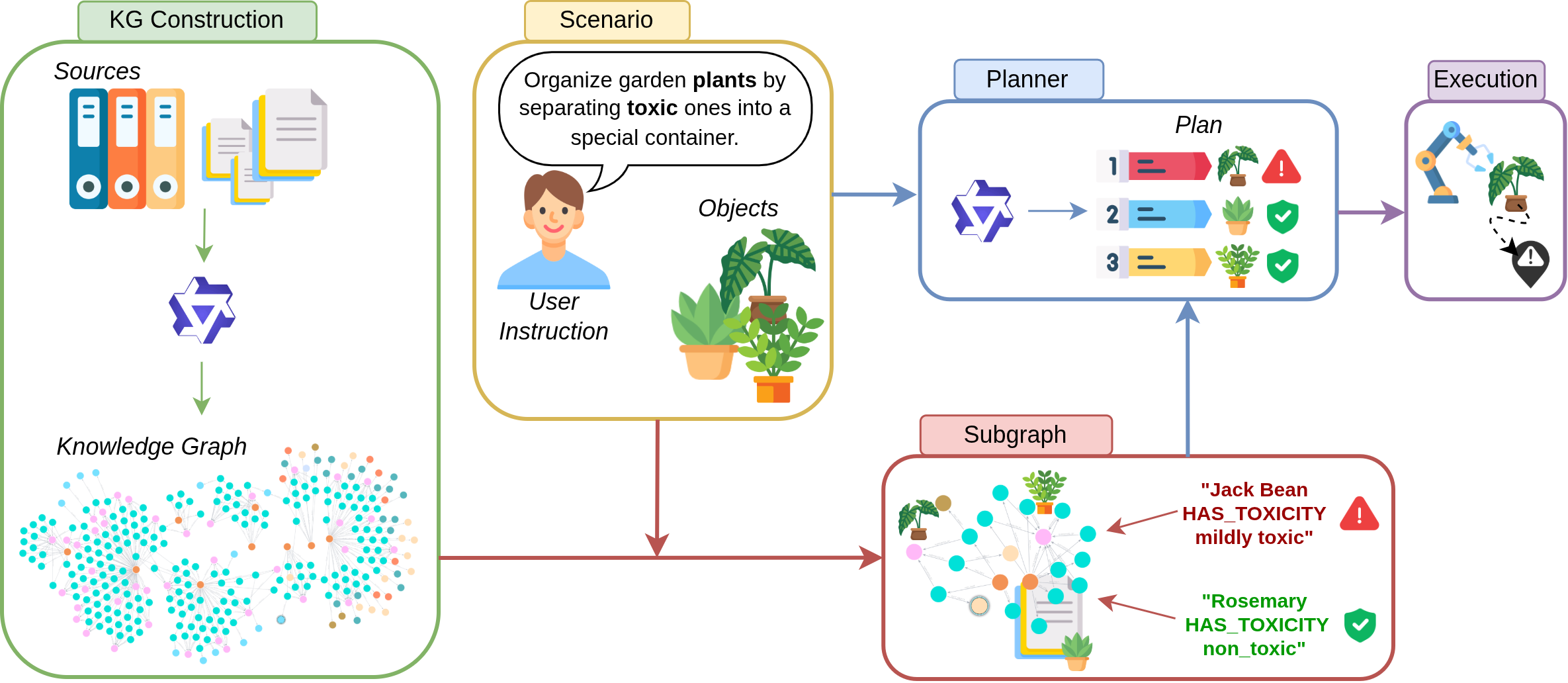
A fully local task-planning framework that turns object-associated text into a persistent knowledge graph with provenance. It retrieves a compact, scene- and task-relevant subgraph, then uses that evidence to guide a local LLM toward grounded JSON subgoals.
The problem
LLM planners can reference objects or actions that are unavailable, or make unsupported assumptions about materials, hazards, and affordances. A transient prompt does not provide a reusable record of what the system knows or where that knowledge came from.
This project builds an inspectable, object-centric memory from scene-associated evidence and retrieves only the context needed for the current instruction.
Approach
Build
Object-centric knowledge memory
Chunk object-associated documents and extract schema-constrained facts with a local LLM. Store each fact in Neo4j with confidence, source metadata, and links to supporting evidence.
Retrieve
Scene- and task-conditioned context
Retrieve facts for the perceived objects and select a compact, diverse subgraph under a prompt budget, balancing source reliability, confidence, and instruction relevance.
Plan
Grounded JSON subgoals
Condition a local LLM on the instruction, scene entities, and selected evidence. Produce ordered subgoals using a restricted action-template library for downstream skills.
Key results
The manuscript compares task decomposition across six categories from the ConceptBot task suite. The selected results below are reported symbolic planning outcomes, not physical robot task-success rates.
86%
Materials
GraphRAG
ConceptBot 70% · SayCan 20% · ConceptBot w/o ConceptNet 51%
96%
Toxicity
GraphRAG
ConceptBot 86% · SayCan 36% · ConceptBot w/o ConceptNet 56%
85%
Implicit tasks
GraphRAG
ConceptBot 87% · SayCan 31% · ConceptBot w/o ConceptNet 64%
75%
Risk-aware tasks
GraphRAG
ConceptBot 76% · SayCan 15% · ConceptBot w/o ConceptNet 58%
GraphRAG improves on full ConceptBot in Materials and Toxicity; full ConceptBot remains slightly stronger on Implicit and Risk-Aware tasks. These results do not establish grasping, collision avoidance, placement stability, or controller robustness.
Scope and limitations
The framework operates at the semantic/task-decomposition layer. Restricted action templates reduce unsupported outputs, but do not replace reachability, graspability, geometric, or interaction-risk checks in downstream robot skills.
Knowledge coverage matters: unresolved object names, missing sources, and broad material or toxicity descriptions can still lead to incorrect plans. Provenance makes those dependencies inspectable; it does not certify the facts or guarantee safe execution.
Technical snapshot
- Graph backend
- Neo4j · Object, Fact, and Chunk nodes
- Knowledge sources
- Object-associated text; Wikipedia in the prototype
- Extraction
- Qwen3-Coder:30B
- Planning
- Qwen3:32B
- Relevance embeddings
- all-MiniLM-L6-v2
- Local model serving
- Ollama
- Output
- JSON subgoals with restricted action templates
- Provenance
- Source metadata, confidence, and evidence-chunk links
- Implementation
- Python · Docker
Publication
Graph-Based Retrieval-Augmented Planning for Robots with Provenance-Aware Knowledge
Accepted for publication in the DSA ISC 2026 proceedings (Springer, LNCS, vol. 16621).
Paper ID 25. The proceedings are forthcoming; final bibliographic metadata and DOI will be added when available. No arXiv version is currently linked.
BibTeX — provisional citation
This is a provisional author/title citation for an accepted, forthcoming paper. It is not the final Springer citation; no DOI, page range, or formal volume title is asserted.
@unpublished{leanza2026graphbased,
  title={Graph-Based Retrieval-Augmented Planning for Robots with Provenance-Aware Knowledge},
  author={Leanza, Alessandro and Roveda, Loris and Spahiu, Blerina},
  year={2026},
  note={Accepted for publication in the DSA ISC 2026 proceedings, Springer, Lecture Notes in Computer Science, vol. 16621, Paper ID 25. Final publication metadata pending.}
}