LLM PLANNING / KNOWLEDGE GRAPHS / ROBOTICS
ConceptBot
Knowledge-Graph–Grounded Commonsense for Task Decomposition in LLM Robot Planning
Accepted in 2026 for publication in Biomimetic Intelligence and Robotics (BIROB).
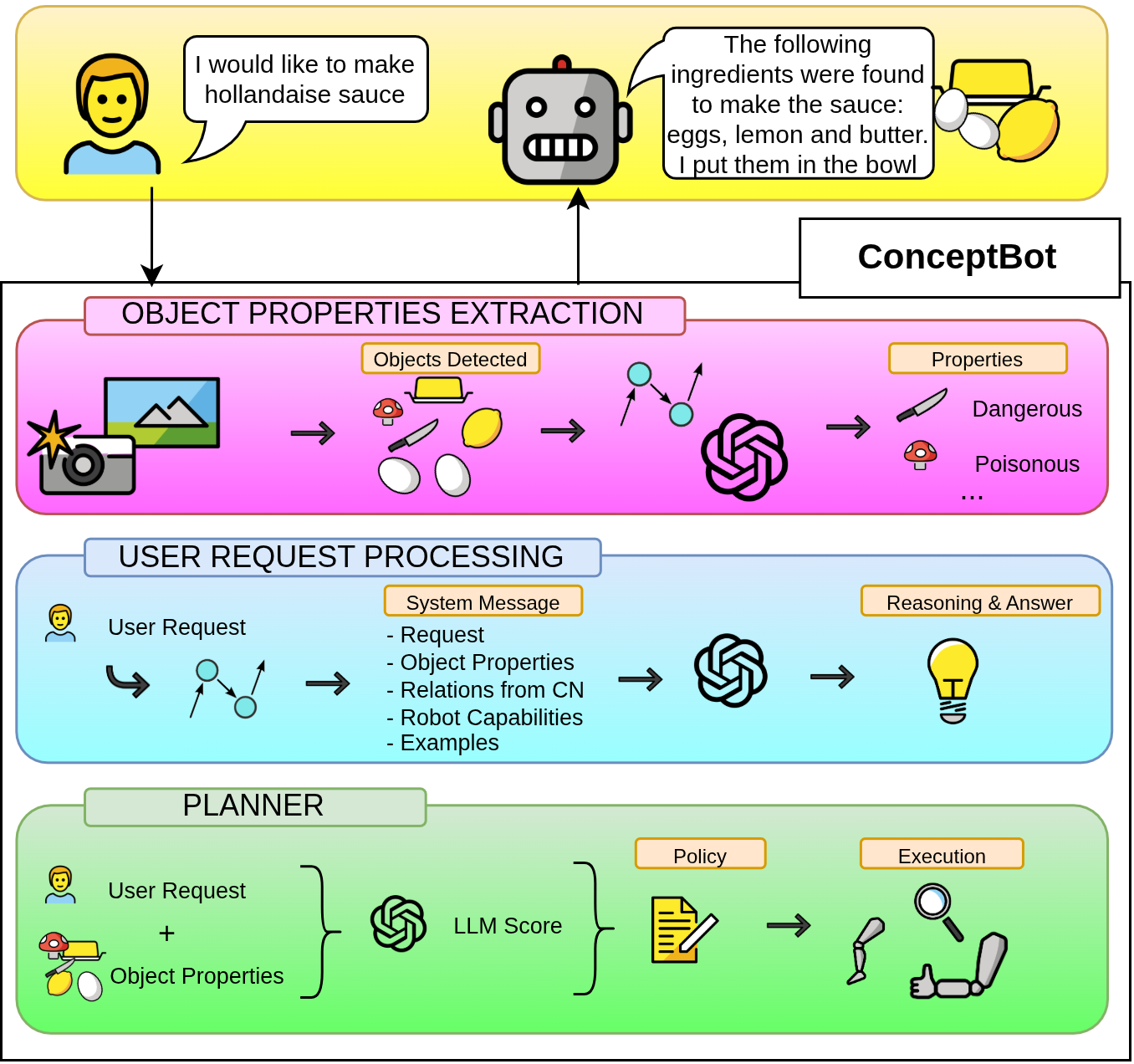
ConceptBot is a modular robot-planning framework that combines large language model reasoning with commonsense knowledge from ConceptNet. It enriches detected objects with task-relevant semantic properties, resolves ambiguous or implicit user requests, and grounds the resulting intent into scene-valid pick-and-place policies.
The problem
LLM-based robot planners can produce plausible action sequences while still missing commonsense information that matters for the task: whether an object is fragile, dangerous, poisonous, suitable for holding liquid, or unsafe in combination with another object.
The problem becomes harder when user instructions are ambiguous or implicit. A request may describe a need rather than explicitly name the object and destination required to satisfy it.
ConceptBot introduces structured external commonsense knowledge before task-level planning, grounding semantic interpretation in the current symbolic scene and the robot’s available action interface.
Approach
OPE
Object Properties Extraction
Retrieves commonsense relations from ConceptNet, filters task-relevant semantic evidence, and infers properties of detected scene objects. In safety-sensitive configurations, it also produces semantic risk information.
URP
User Request Processing
Combines the natural-language instruction with robot capabilities, detected objects, semantic relations, and OPE-derived properties to resolve ambiguity and produce structured object–destination operations.
Planner
Grounds the structured request into sequential, scene-valid pick-and-place actions while tracking the execution history and terminating with done() once the requested operations are complete.
Key results
ConceptBot was evaluated on a 47-instruction symbolic planning benchmark spanning unambiguous, ambiguous, implicit, risk-aware, materials, and toxicity tasks. The percentages below measure planning-policy correctness rather than physical robot task success.
87.0%
Implicit tasks
Full ConceptBot
SayCan 31.0% · ReAct 27.0% · ProgPrompt 13.0%
76.2%
Risk-aware tasks
Full ConceptBot
SayCan 15.0% · ReAct 37.5% · ProgPrompt 22.5%
80%
SafeAgentBench BSS
Observed overall BSS
Next-highest reported comparison: ReAct + ThinkSafe, 46%
45 / 50
Controlled task completions
PyBullet + Franka deployments
All 45 / 45 planning-correct policies completed execution
The symbolic benchmark evaluates task-level policy correctness. The controlled robot runs separately demonstrate planner-to-execution integration under supported perception and manipulation conditions; they do not establish general perception, grasping, placement-stability, or controller robustness.
Why grounding matters
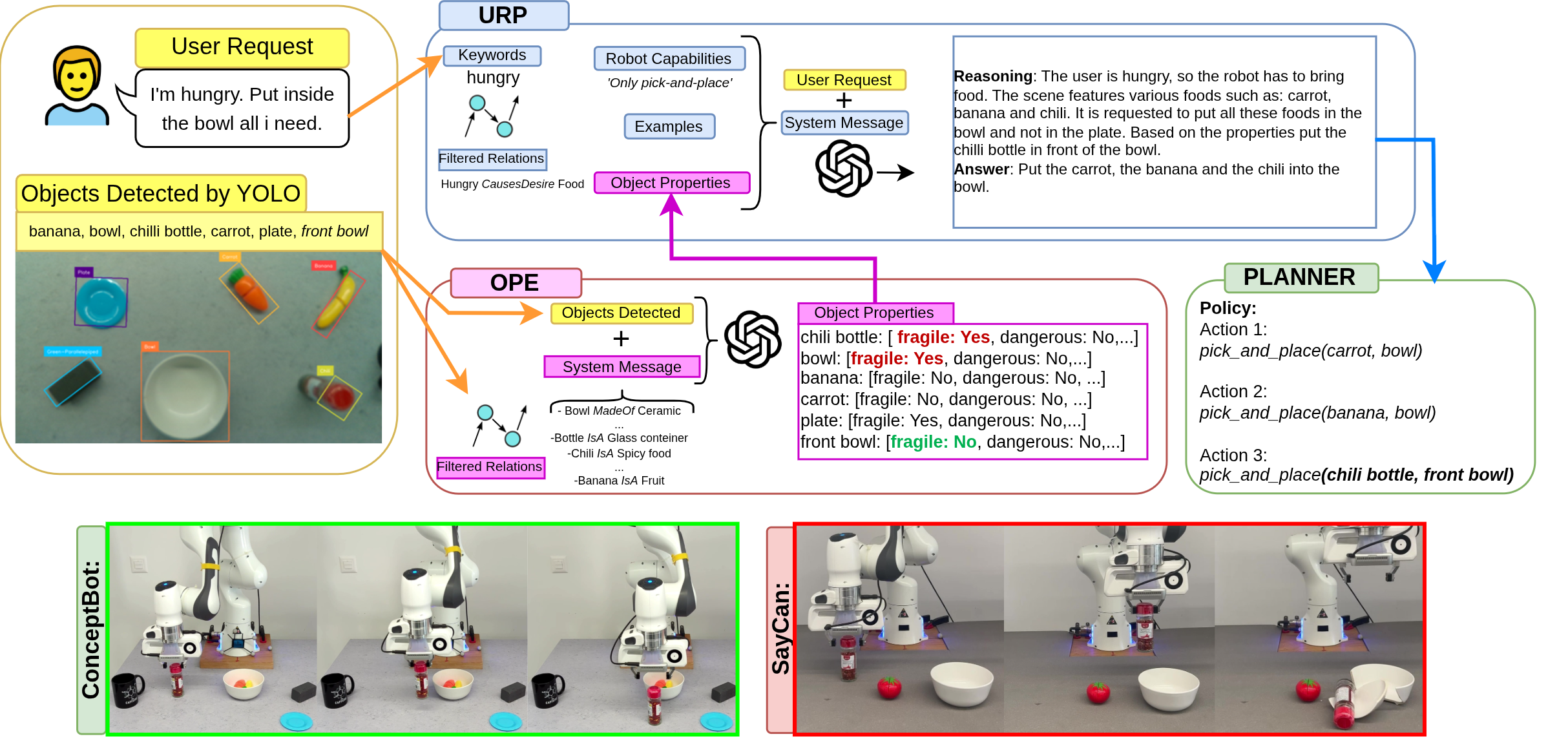
In a representative risk-sensitive task, the baseline places a bottle inside a ceramic bowl, creating a potential breakage risk. ConceptBot uses object-property and risk information through OPE and URP to construct a safer structured request, placing the bottle in front of the bowl instead.
From symbolic planning to robot execution
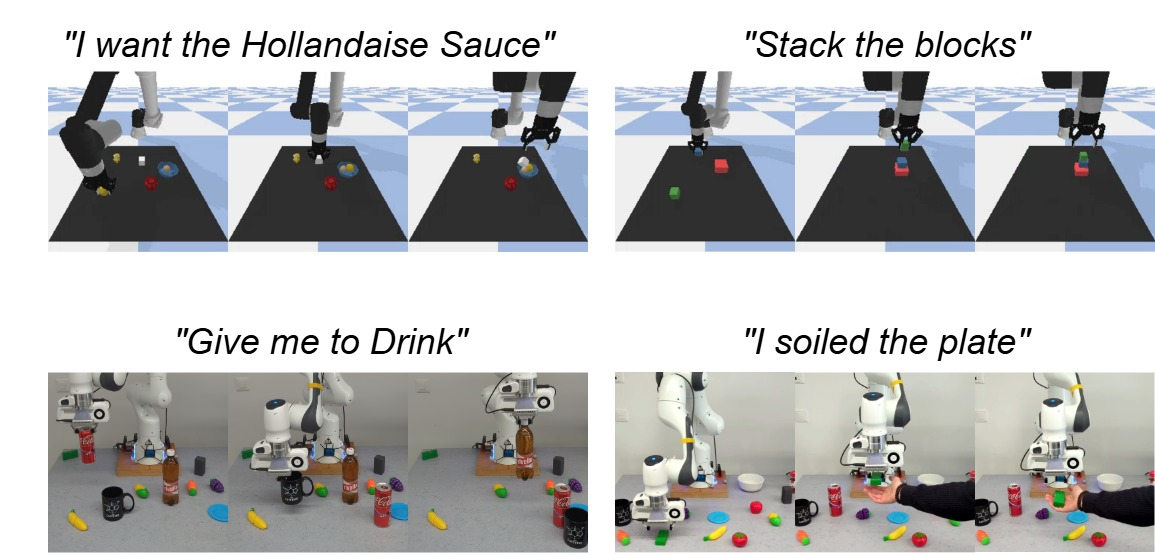
ConceptBot was integrated with both simulation and physical manipulation stacks. In simulation, representative tasks used a UR5e robot with a Robotiq 2F85 gripper in PyBullet, with CLIPort used for pick-and-place execution. Real-world trials used a Franka Emika Panda with an Intel RealSense D435 RGB-D camera, YOLOv8 object detection, and FrankaPy for execution.
The deployment experiments were intentionally separated from the symbolic benchmark so that planning-policy correctness is not confused with end-to-end perception or control performance.
Technical snapshot
- Knowledge
- ConceptNet commonsense knowledge graph
- Reasoning
- Large language models with structured prompting
- Core modules
- OPE · URP · Planner
- Planning interface
- Scene-valid pick-and-place actions
- Simulation
- PyBullet · CLIPort
- Real robot
- Franka Emika Panda · FrankaPy
- Perception
- YOLOv8 · Intel RealSense D435
- Evaluated LLM backbones
- GPT-4o-mini · DeepSeek-R1 · Llama-3.3-70B-Instruct
- Implementation
- Python · Docker
Evaluation design
Benchmark composition and policy evaluation
The benchmark contains 47 expert-validated instructions. Each instruction is evaluated through 10 complete policy-generation repetitions, with the instruction—not an individual model call—treated as the statistical unit.
Admissible policies are evaluated against expert-validated sets of task outcomes rather than against a single literal action sequence. This allows alternative valid solutions while still rejecting missing, duplicated, invalid, unsafe, or unrequested actions.
- 7 unambiguous
- 10 ambiguous
- 10 implicit
- 8 risk-aware
- 7 materials
- 5 toxicity
Publication
ConceptBot: Knowledge-Graph–Grounded Commonsense for Task Decomposition in LLM Robot Planning
Accepted in 2026 for publication in Biomimetic Intelligence and Robotics (BIROB).
The arXiv preprint is available below; the citation will be updated when the final publication metadata become available.
BibTeX — arXiv preprint
This is the arXiv/preprint citation; it can be replaced with final publication metadata when available.
@article{leanza2025conceptbot,
  title={ConceptBot: Knowledge-Graph--Grounded Commonsense for Task Decomposition in LLM Robot Planning},
  author={Leanza, Alessandro and Moroncelli, Angelo and Vizzari, Giuseppe and Braghin, Francesco and Roveda, Loris and Spahiu, Blerina},
  journal={arXiv preprint arXiv:2509.00570},
  year={2025}
}